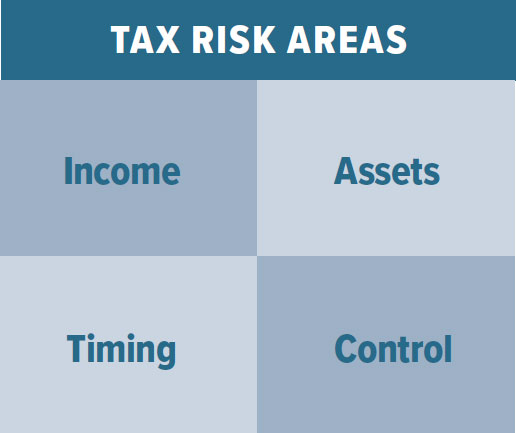
It is critical to understand what may cause your private asset strategy and RIC tax qualifications to be misaligned. Due diligence and ongoing monitoring are critical and significantly more involved than traditional asset classes. It’s necessary to manage the main tax risk areas: unknown bad income and unknown bad gross income, bad assets, delayed timing of tax reporting and lack of control over underlying private assets.
Gross Income Test Failure
When it comes to RICs with private assets, the gross income test leaves less room for error than the asset diversification tests. Unlike the asset tests, the risk of failure generally does not decrease as the portfolio grows and can range year-to-year. The fund must derive 90% of its income from qualified sources. Traditionally, most funds that invest primarily in securities are nowhere near the 10% limit. However, alternative assets tend to generate significant amounts of bad income and can easily cross this threshold. RICs were not created with the intent to invest in operating businesses, and the rules around non-security- type income are very strict.
Cure Provision: A RIC that fails the income test can avoid losing its beneficial tax status using a cure provision, provided the failure is due to reasonable cause and not willful neglect. The RIC, however, must pay 100% tax on its excess nonqualified income, which may be prohibitively expensive. The cure for this test failure is also associated with enhanced tax return disclosures as a requirement to curing.
Example: Let’s say a RIC earns $100,000 of gross income in a given tax year. When calculating the test, it is discovered there is $15,000 of nonqualified income from real estate investments through a partnership. This puts the fund at 85% qualified gross income, which triggers a failure because it is less than the 90% good income requirement. If the fund wants to maintain RIC status, the fund would pay tax on the amount over 10% of nonqualified income. In this example, the fund pays $5,000. The math is simple and results in dollar-for-dollar tax. This tax can become punitive and expensive very quickly.
- $100,000 income x 90% required good income = $10,000 bad income allowed
- $15,000 bad income earned - $10,000 bad income allowed = $5,000 excess bad income
- $5,000 excess bad income x 100% tax = $5,000 tax due
Corporate Tax Alternative: While this is not generally the obvious answer, curing a failure may be more expensive than paying corporate tax (forgoing the RIC status for a year). This is generally true if the RIC has large expenses or losses, that, while excluded from the gross income test, could lower its tax liability to less than the RIC failure tax or even put the fund in losses. It is worth exploring this alternative option if it results in tax savings. However, this solution provides its own compliance and reporting complexities to consider and is a significant undertaking. A consideration should be given to shareholder communication in a corporate scenario, because shareholders are likely to have a difficult time understanding the reason for the corporate taxes.
State Tax Consideration: An item worth noting is that while the fund may somehow avoid federal tax, it is unlikely it could avoid state taxes. If a fund is taxed as a corporation for a year, the state tax consequences of the single year change are likely to impact the fund for years after the issue is resolved.
In Practice: Curing an income failure or losing RIC tax status could be expensive and involved from a tax liability and operational standpoint. Involving tax providers early is important, but it also requires involving the entire team that services all needs of the fund, as there are considerations around NAV impact, financial statement disclosures, requalification and others. Ultimately, the best shareholder outcome across all options should drive the decision.
The Two Year Issue: Regardless of whether the fund retains or loses RIC status, once a fund has failed, the steps to correct the failure are often slow and time consuming. Assets often need to be disposed of or moved to a blocker. Unfortunately, it is possible that once a fund has failed, due to timing of K-1 income recognition, next year’s tests may also be in jeopardy. This is another reason to monitor and run preliminary analysis of the tests. It is important to have the ability to quickly get ahead of potential failures, even if the failure in the current year is unable to be corrected in time.
Waiting for Bad Income
There are several options to deal with the receipt of bad income, such as potential cure provisions, if available, or various blockers. These potential fixes are all subject to specific timelines; if the opportunity is missed, it could be too late to act. Contributing bad assets to a blocker must happen before the fund receives the bad income, or it would not be an effective solution to the problem. Bad income is best dealt with ahead of time through a GP sponsored blocker or a wholly owned subsidiary. One of the common pitfalls in the industry is waiting to see what is reported on the K-1. Uncertainty around the exact amount and exact character of income has too many risks with expensive consequences. If control and transparency are impossible, do not wait to address a potential income issue. Having due diligence on the front end to block potential tax issues is the best line of defense, as often partnership bad income is not known for a year or two after initial investment.
Asset Diversification Test Failure
Cure Provisions: The cure provisions for the asset tests failure are somewhat more lenient than the cure for income test failures.
- Market Value Exception: First, after a RIC has satisfied the asset tests in its initial quarter, it will not be considered to have failed the tests in a subsequent quarter solely due to fluctuations in the value of its assets.
- 30-Day Cure Provision: There are also cures available that relate to disposing of assets within certain time frames of the failure. The 30-day cure, as the name implies, allows the fund to make appropriate dispositions of bad assets within 30 days of the failing quarter to get to a position that, if those trades had occurred prior to quarter-end, the fund would have passed the tests. This cure is very valuable to traditional portfolios of securities, as they are easily valued and sold. Portfolios with private assets require time to finalize their valuation. Often final NAV may not be available within 30 days; therefore, the fund may not have the result of the asset tests and not have sufficient time to cure.
- De minimis and Non-de minimis Cure Provisions: The de minimis and non-de minimis cures also require sales of the failing assets but allow for a six-month sale period and may require a tax payment. In practice, most asset cures are difficult to implement with an illiquid portfolio where the fund may be unable to exit these investments in the designated periods, 30 days or six months.
Loss of RIC Status
If the RIC is unable to use any of the cures discussed, it will be taxed as a corporation subject to 21% federal tax and any applicable state taxes on its current taxable income.
Depending on facts and circumstances, what happens next could vary widely:
- The RIC can reelect RIC status in the following year once back in compliance, subject to certain limitations.
- If the RIC is not eligible to reelect RIC status or unable to become compliant with the RIC rules timely, it might be subject to deferred taxes on its unrealized capital gains. This is likely the worst case scenario for any fund. There might be the unfortunate need to assess accuracy of past NAV for current and deferred taxes. At this point, requalifying and dealing with the current and deferred taxes becomes immensely complex. This result could be difficult or even impossible to undo for years to come.
Industry Knowledge and Technology Gap
In Practice: It is important for an adviser to consider their own in-house tax expertise and the expertise of the fund providers. This looks different depending on the circumstances. Many private fund sponsors want to access the registered fund space. The switch from a less regulated to more heavily regulated industry requires adjustment. There are also many traditional registered fund sponsors seeking exposure to private assets. This brings a completely different set of expertise, where management understands the product and distribution channels but not necessarily the tax complexities of the investments. There is also a consideration for the service providers that perform daily operations or audit the funds.
It is important to know the experience of all parties involved and attempt to bridge the gap. There is no one-size-fits-all recommendation, but there is a need to understand the situation — and approaching it with a risk mitigation mindset is key. It is worth considering a process that involves all departments at the adviser and all service providers, as opposed to building a small team dedicated to a private asset fund. Involving all available resources could be a better long-term approach to structuring and monitoring a successful product.
Any of the following could be invaluable to running a smooth(er) operation:
- Ensure flow of information between the portfolio managers/deal team and the tax team.
- Educate portfolio managers and operations team on good versus bad income and the importance of that distinction.
- Include the tax team in the due diligence process.
- Create a set of tax questions, checklist or information request tool that covers basic questions required to be answered for each new investment. This is particularly relevant to interval funds that tend to have portfolios with diverse tax entity types and income/asset tax considerations.
- Establish a source of tax information, including how, when and from where the tax team will receive the information it needs. Unlike traditional security investments, most necessary tax information and reporting is not publicly available. While this seems like a simple distinction, it could mean the difference between success and failure.
- Focus on establishing policies and procedures. This will also help with establishing “reasonable cause” in the event of a test failure.
- Consider performing pre-deal qualification testing to ensure compliance with RIC rules. Plan for valuation uncertainty and its impact on the tests.
While these are all tax considerations, it takes the entire team to keep a fund in compliance with the tax rules.
Technology and Innovation: Lastly, the 1940 Act industry is a very robust and efficient industry, offering the benefit of many years of experience, great automation of most processes and amazing access to publicly available information. Private asset workflows are difficult to incorporate in standard fund operations. Existing platforms and tools may not be best suited for the information flow from private markets. It will be important to assess potential innovation needs in fund administration, compliance and reporting. Portfolio monitoring and valuation management are beyond the scope of this analysis, but they also present their own challenges with private market investments.
Lack of Control in Private Investments
Liquidity: The RIC rules were written for highly liquid investments. Most RIC cures revolve around exiting a position quickly, which might not be possible with these highly illiquid assets. This is especially relevant to secondary transactions. There may be many unexpected events that can cause RIC qualification issues — bad income from K-1s, lack of estimates, capital deployed in unexpected ways and others.
This inability to exit investments or lack of control over lower tier partnership activity requires planning. A blocker is a great way to avoid these tax concerns, but advisers must be aware of blocker limitations and consider the potential tax drag.
Private Debt: There may also be times when the fund does not expect to receive equity interest and is given an equity kicker in a debt deal, or the debt converts to an equity position. The time between receiving the equity and disposition of the equity may generate nonqualified income, even if disposition is an option. There is also the potential of debt investment defaulting where the fund receives the collateral, which often is a bad asset that generates bad income. While these are relevant considerations for any debt funds, these are common issues for BDCs.
Conclusion
While RIC investments in private assets can create potential tax risks, careful diligence may mitigate such risks significantly or completely, resulting in immense shareholder benefits. However, it is impossible to mention all tax complexities and types of alternative investments. This discussion is simply a guide to help understand foundational but key tax concepts and to help know which questions to ask. Use this analysis to recognize tax challenges, anticipate potential pitfalls and have productive discussions with your tax advisers.
Contact Us
Our team works with approximately one-third of the interval and tender offer fund market across diverse asset classes, including private investments, REITs, derivatives and direct real estate. What sets us apart is our ability to simplify the complex. Working with some of the most innovative investment managers, our team — 100% dedicated to the investment industry — offers in-depth insights on industry trends, direct experience and a holistic perspective.


Thank you to Brett Eichenberger, Stephen Fisher, Jay Laurila, Eric Lemmon, Erin McClafferty, Rob Meiner, Andreana Shengelya and Claire Toraason for contributing to this publication.