When a Real Estate Investment Trust (REIT) plans to go public, balancing its strict requirements is critical. An essential part of that balance is maintaining a REIT’s special tax status under the IRS rules, which generally allows a REIT to avoid federal corporate income tax on distributed taxable income if it satisfies the REIT qualification requirements and distribution tests. Although REITs generally do not record federal corporate income tax at the parent level, ASC 740 (Income Taxes) remains highly relevant because of taxable REIT subsidiaries (TRS), state tax exposure, built-in gains taxes and uncertain tax positions.
In Part 3 of our series on taking a REIT public, we focus on tax structuring and REIT compliance related to the impact on ASC 740. While it is important for your team to engage a tax specialist with in-depth knowledge on REIT taxation and real estate tax structuring, it’s also important for you and your financial team to understand the basics of how tax will impact your public REIT. Regardless of your role in the finance function, a REIT is a tax-driven entity, which means you will need to develop just enough tax knowledge to help your REIT meet financial reporting and tax compliance goals each year.
This final installment in our series aims to help you gain the high-level knowledge you need, highlighting essential disclosures and REIT compliance considerations every financial reporting professional and REIT executive should be familiar with as a foundational resource for their journey in the sector.
>> Read Part 1 of our series: “Private REITs Going Public: Internal Controls and Governance”
>> Read Part 2 of our series: “Accounting and Financial Reporting for Public Markets”
Introduction to REIT Taxation and ASC 740
IRS Tests: Foundation of REIT Status
A REIT is a company that follows certain rules about how it earns income, what types of assets it holds, who owns it and how it pays out its earnings. By meeting these requirements and electing to be taxed as a REIT via Form 1120-REIT, the company can avoid paying federal income tax on the profits it distributes to its shareholders, as long as it keeps its REIT status.
However, even though REITs generally don't pay federal income tax at the parent level, accounting rules under ASC 740 still require these companies to carefully review and report their overall tax situation. This is especially important when it comes to the company’s TRS, state and local taxes, potential taxes on gains from selling assets and positions that might be challenged by tax authorities.
The cornerstone of REIT compliance lies in satisfying a series of REIT qualification tests. These rules are designed to ensure REITs operate primarily as a real estate investment vehicle and deliver the intended tax advantages. For public filers, strict adherence to these rules is critical. A failure can result in loss of REIT status, triggering corporate-level taxation and undermining investor confidence resulting in lawsuits and upset investors.
REIT Qualifications
REITs must satisfy strict income, asset, ownership and distribution tests to maintain their tax-advantaged status.
Income Test
- Gross income: At least 75% of a REIT’s gross income must be derived from real estate-related sources, such as rents from real property, interest from mortgage loans to rental properties, dividends from investments in other REITs, income from foreclosed properties, income from temporary investments or gains from the sale of real estate assets. The remaining income may come from other passive sources, but excessive nonqualifying income jeopardizes REIT status. At least 95% of gross income must be derived from qualifying sources, including income that qualifies for the 75% test, along with dividends, interest and certain other passive investment income.
- Qualifying income: Rental income, mortgage interest, capital gains from property sales
- Nonqualifying income: Fees from property management, hotel operations or certain service activities
>> Example: A REIT owning office buildings predominately earns rental income from its leases with tenants. If it expands into property management services, careful structuring is needed to ensure the income flows through a TRS to still satisfy the income test.
Asset Test
- REIT assets: At least 75% of a REIT’s assets must consist of real estate, cash or government securities. The remaining assets may include other investments, but excessive holdings in nonqualifying assets can lead to disqualification.
- Qualifying assets: Real property, mortgages, cash, government securities
- Nonqualifying assets: Partnership interests, certain equity investments
>> Example: A REIT with significant investments in partnership interests must monitor asset composition to ensure compliance.
Ownership Requirements
- A REIT must meet the 100-shareholder requirement and the 5/50 test i.e. have at least 100 distinct beneficial owners. This also means a REIT cannot be closely held by a small group. Additionally, to avoid dominance by a handful of individuals, no more than 50% of a REIT's shares can be owned by five or fewer people.
These requirements help maintain a REIT's public character and support its intended purpose of offering everyday investors access to diversified real estate investments. As for private REITs, this aspect is not as important other than ensuring the company meets the IRS requirement.
>> Example: If a REIT finds itself with too few owners or too high of a concentration among its largest shareholders, it may need to encourage broader investment or adjust its share distribution to avoid regulatory issues — whether going to the outside marketplace for a public REIT or bringing in high-net-worth investors for a private REIT to ensure compliance with the requirement.
Distribution Requirement
- Taxable income distribution: REITs must distribute at least 90% of their taxable income to shareholders annually, typically in the form of dividends. This requirement is central to a REIT’s tax advantage, as income distributed to shareholders is generally not taxed at the corporate level.
- Distribution timing: Most REITs pay quarterly dividends, but annual compliance is critical.
- Retained earnings: Excess retention can trigger corporate tax liability.
>> Example: A REIT that under distributes due to cash flow constraints must evaluate potential tax consequences and investor reactions.
The tests described above provide a high-level summary of complex IRS regulations. Each test comes with pages of rules and plenty of exceptions. That’s why it’s so important for your financial reporting team to work closely with a tax expert who can help navigate the details and help ensure full compliance with the intricacies of the REIT rules.
Compliance Strategies and Consequences of Failure
If a REIT fails to follow these rules, the consequences can be severe. The company could lose its REIT status for possibly up to five tax years after its REIT status termination and potential ineligibility to re-elect REIT status for five taxable years absent IRS relief; and be taxed like a regular corporation, which usually leads to much lower returns for investors. In other words, staying compliant is essential for keeping a REIT’s special tax benefits and protecting shareholder value.
To stay on track, REITs need strong systems that constantly check their compliance with IRS rules. This includes regularly reviewing their income and assets, planning out dividend payments and quickly addressing any issues that arise. If a REIT doesn’t meet these requirements, it could mean:
- Losing its REIT status
- Paying corporate taxes on all its income
- Owing extra penalties and interest
- Damaging investor trust and seeing its market value drop
To help REITs avoid the serious consequences of noncompliance, there are several practical steps management teams can consider taking:
- Implement monitoring systems: Investing in reliable technology or, more practically for new REITs, hiring a professional service firm that specializes in REITs and has the relevant knowledge base can make a significant difference. Monitoring can routinely track and analyze a REIT’s income streams and asset composition, flagging any irregularities or potential compliance risks before they become significant problems. This oversight helps ensure the company remains within the IRS’ strict requirements and can respond quickly to any shifts in financial data.
- Establish transparent dividend policies and contingency plans: Setting up clear, written guidelines for dividend payments gives a REIT a consistent framework to follow. It’s also wise to develop backup strategies in case cash flow becomes constrained. This will help a REIT still meet its required distributions to shareholders even during challenging periods.
- Foster an ongoing relationship with tax advisers: Compliance requires frequent review and adjustment. By regularly consulting with experienced tax professionals, REITs can stay updated on regulatory changes, perform periodic compliance audits and resolve any emerging issues early on. This collaborative approach not only helps safeguard a REIT’s tax-advantaged status but also supports long-term shareholder value.
Ultimately, taking a proactive and thorough approach to compliance through technology, strong policies and expert guidance helps REITs avoid costly mistakes and maintain the trust of their investors.
As companies move closer to an IPO, tax compliance becomes only one part of the equation. Equally important is selecting a structure that supports capital raising, acquisitions and long-term growth in the public markets.
UPREITs and Operating Partnership Models
Public REITs often adopt sophisticated entity structures to balance compliance, operational flexibility and tax efficiency. The most prevalent model is the UPREIT (Umbrella Partnership REIT), which leverages an operating partnership structure. In a UPREIT structure:
- A REIT holds a controlling interest in an operating partnership, which owns the underlying real estate assets.
- Property owners can contribute assets to the operating partnership in exchange for partnership units, enabling tax-deferred exchanges under Section 721 of the Internal Revenue Code.
- Operating partnership units may be convertible into REIT shares, offering liquidity and alignment with public investor interests.
- For financial reporting purposes, the operating partnership is consolidated with a REIT for the financial statements.
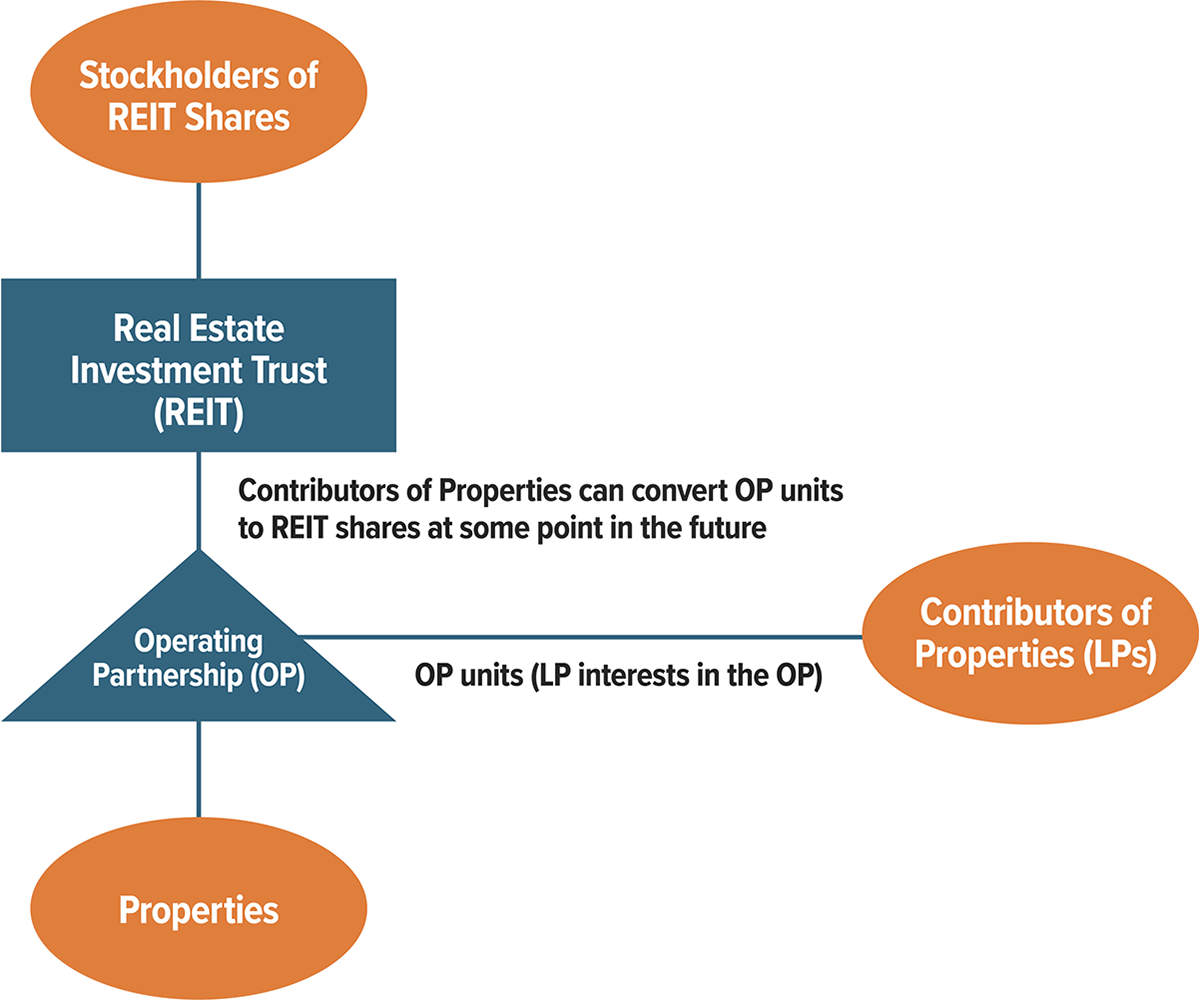
>> Example: A private REIT preparing for an IPO invites several property owners to contribute assets to the operating partnership, receiving operating partnership units instead of cash. This enables tax deferral for the contributors and expands a REIT’s asset base without triggering immediate gain recognition. After the IPO, operating partnership units can be converted to REIT shares, providing liquidity and market alignment.
The UPREIT structure has become the predominant public REIT model because it facilitates tax-deferred property contributions while providing acquisition currency through operating partnership units.
Public market investors often evaluate REITs not only on asset quality and earnings potential, but also on the sustainability of their tax structure. Strong REIT compliance processes, thoughtful use of TRSs and clear tax disclosures can reduce uncertainty and support investor confidence following an IPO.
Taxable REIT Subsidiary (TRS)
A TRS helps REITs handle income that wouldn’t qualify under the strict REIT rules, like running hotels or offering property management and development services. Essentially, a TRS is a regular company owned by a REIT, and it can conduct business a REIT cannot without risking its special tax status.
There are a couple of important rules to keep in mind:
- A REIT can’t have more than 25% of its total assets in the TRS, and
- Any deals between a REIT and its TRS must be made as if they’re between unrelated parties, to ensure fairness and prevent tax issues related to transfer pricing.
While a REIT entity itself may generally avoid federal income taxation, a TRS is fully taxable as a C Corporation. ASC 740 applies in full to TRS activities, and their impact on the consolidated financial statements is often significant:
- The TRS must recognize current and deferred taxes on temporary differences.
- A REIT must assess uncertain tax positions (UTPs) related to TRS operations, including intercompany transactions that may generate temporary differences.
- Most of a REIT’s consolidated tax expense, deferred tax balances, and UTPs stem from TRS activities.
>> Example: A REIT with some hotel operations channels all hotel income through a TRS. The TRS pays corporate tax on its earnings, but the structure protects a REIT’s qualification by isolating nonqualifying income.
Accounting Issues and Financial Statement Disclosures Under ASC 740
Deferred Taxes in a REIT Structure
Despite the general exemption from federal tax at the REIT parent level, deferred tax considerations remain relevant in several areas, as discussed below. These tax effects are recorded in a REIT’s financial statements and, therefore, help ensure accurate reporting and compliance with accounting standards.
- TRS operations. As previously mentioned, a TRS is subject to the typical rules of deferred tax accounting outlined in ASC 740. When a REIT owns and operates a TRS, the TRS is taxed as a regular corporation. This means the TRS must calculate and recognize deferred tax assets and deferred tax liabilities based on the differences between the book and tax value of its assets and liabilities.
- State and local taxes. While REITs often benefit from federal tax advantages, state and local tax rules can differ significantly. In some states, REITs are subject to income tax, regardless of their federal exemption. In these situations, a REIT needs to recognize both deferred tax assets and deferred tax liabilities, as well as the current tax expense related to state and local taxes. This involves assessing temporary differences and potential future tax consequences, much like any other taxable company. Accurate recognition of these amounts is important for proper financial reporting and for understanding a REIT’s overall tax position.
- Built-in gains tax. If a C Corporation converts to a REIT, there is potential for a corporate level tax on the sale of appreciated assets, known as the built-in gains tax. This tax applies if a REIT sells assets that had appreciated in value prior to the conversion, and the sale occurs within a specific recognition period (currently five years). To reflect this future tax exposure, a REIT must recognize a deferred tax liability for any potential built-in gains tax on these assets.
- Nonqualifying income or assets. Not all income or assets held by a REIT are eligible for the beneficial tax treatment associated with REIT status. Income from certain business activities or assets may be considered "nonqualifying," subjecting it to regular corporate income tax. In these cases, a REIT must perform an ASC 740 analysis to determine the appropriate amount of deferred tax assets and deferred tax liabilities and recognize them in the financial statements.
Uncertain Tax Positions (UTPs) and ASC 740-10
ASC 740-10 mandates that REITs evaluate UTPs, with unique considerations. Under ASC 740, a tax position generally must satisfy the 'more-likely-than-not' recognition threshold before tax benefits can be recognized in the financial statements. If there are any uncertainties, then appropriate disclosure and recording of any potential liabilities should be recorded for each of the following:
- Ongoing REIT qualification: Determining whether a company continues to qualify as a REIT is not always clear. This process is considered an uncertain tax position because there may be areas where the IRS could interpret the rules differently or challenge the company's status. If, after careful evaluation, management concludes it is more likely than not the IRS would dispute the company's REIT qualification, accounting standards require the company recognize a liability for potential tax exposure.
- TRS transfer pricing: When a REIT owns a TRS, the two entities may engage in intercompany transactions, such as charging management fees or sharing administrative services. The pricing and terms of these transactions must be set as if the parties were unrelated, in accordance with transfer pricing rules. However, there is often uncertainty about whether these arrangements meet the IRS’ standards. This uncertainty qualifies as a UTP, and a REIT needs to evaluate and document its approach to ensure it is defensible in the event of an IRS review. If there is significant doubt, a REIT may need to recognize a liability for potential adjustments.
- State nexus and apportionment: REITs that operate across multiple states face additional layers of tax complexity. Each state has its own rules about what activities create a "nexus," a sufficient connection to impose state income tax, and how income should be apportioned among the states. These rules can differ significantly from federal law and from state to state, leading to uncertainty about whether a REIT has properly identified all of its tax obligations. Such uncertainties are also treated as UTPs. As a result, REITs must regularly assess their operations and the evolving state tax landscape, documenting their positions and recognizing liabilities where it is likely a state authority could challenge their conclusions.
Financial Statement Disclosures Under ASC 740
Public REITs are required to provide detailed and transparent disclosures about their income tax positions and calculations, especially as new standards such as Accounting Standards Update (ASU) 2023-09 take effect for fiscal years beginning after December 15, 2024. These requirements are designed to help investors, regulators and other stakeholders understand how a REIT manages its tax obligations and risks. Let’s break down what this means in practice:
- Current and deferred tax expense: REITs must clearly report their tax expenses, not just as a total, but separated by the type of jurisdiction — whether federal, state or foreign taxes. Additionally, they must distinguish between taxes arising from their core REIT activities, if any, and those stemming from TRS operations. This level of detail helps readers see where taxes are being incurred and which parts of the business are driving those expenses.
- Deferred tax assets and liabilities: In their financial statements, REITs need to explain what deferred tax assets and liabilities they have, including any allowances set aside in case some of these assets may not be recovered. They must also highlight significant temporary differences where income or expenses are recognized differently for accounting and tax purposes. This information shows how timing differences may impact future tax payments or benefits.
- Rate reconciliation: Even if a REIT’s federal tax expense is low, a REIT must reconcile the statutory tax rate (what the law says) with their effective tax rate (what they actually pay). This reconciliation is required to highlight any major factors that cause the rates to differ, such as income exempt under REIT rules or taxes paid by TRS entities. By doing this, a REIT provides clarity on how its unique structure impacts its tax burden.
- Unrecognized tax benefits: REITs must disclose information about uncertain tax positions, where there’s a chance an IRS or another authority might disagree. They need to show how these unrecognized tax benefits have changed over time, report any related interest or penalties and describe the nature of any material uncertainties. This helps financial statement users understand areas where a REIT might face future tax challenges.
- ASU 2023-09 expanded disclosures: The new standards require even more granular information. REITs must provide breakdowns of income taxes actually paid, separated by jurisdiction. They must use standardized categories in their rate reconciliations so comparisons are easier across companies. Finally, they need to offer qualitative explanations for any major reconciling items, giving context for why the numbers look the way they do. In addition, a TRS may generate deferred tax assets related to net operating losses, interest limitations or other temporary differences. Management must assess whether a valuation allowance is necessary based on the likelihood of future taxable income.
In short, these expanded disclosure requirements require public REITs to paint a clear, comprehensive picture of their tax situation. This enables investors and regulators to make more informed judgments about a REIT’s financial health, risk profile and compliance with tax laws.
The Strategic Value of Robust Tax Structuring for Public REIT Success
ASC 740 remains highly relevant for public REITs despite their general exemption from federal corporate income tax. Key considerations include the presence of taxable REIT subsidiaries, state and local taxes, built-in gains, uncertain tax positions and evolving disclosure requirements. Robust processes for ongoing REIT qualification, UTP evaluation, and compliance with expanded disclosure standards are critical for effective financial reporting and risk management.
Tax and structuring considerations are the design elements that define investment-ready platforms for REITs aspiring to public market success. The transition from private to public status requires strategic structuring that optimizes investor returns and sustains REIT qualification over the long term. By embracing best practices, engaging expert advisers, and prioritizing investor focused planning, REITs can position themselves as credible, scalable and competitive platforms for institutional capital.
Contact Nick Antonopoulos, Asha Shettigar or a member of your service team to discuss this topic further.
In this blog Cohen & Co is not rendering legal, accounting, investment, tax or other professional advice. Rather, the information contained in this blog is for general informational purposes only. Any decisions or actions based on the general information contained in this blog should be made or taken only after a detailed review of the specific facts, circumstances and current law with your professional advisers.